
Embedded Network
Renewals
Improve Outcomes for Your Building & Occupants.
Many embedded networks are established once and rarely tested again. Over time, pricing, contract terms and service performance can drift away from current market conditions without clear visibility for the Owners Corporation.
As the market leaders in independent embedded network procurement, Utilizer runs a full-market review to test your existing arrangement, challenge incumbent providers and secure stronger commercial outcomes for your building and its residents.

Common Challenges That
We Help Solve.
Contracts approaching expiry or renewal
– Occupant concerns about high energy or utility costs
– Limited pricing transparency or complex billing structures
– Poor service performance or slow issue resolution
– Networks established without independent advice or market testing
Limited visibility or engagement with your embedded network operator or manager
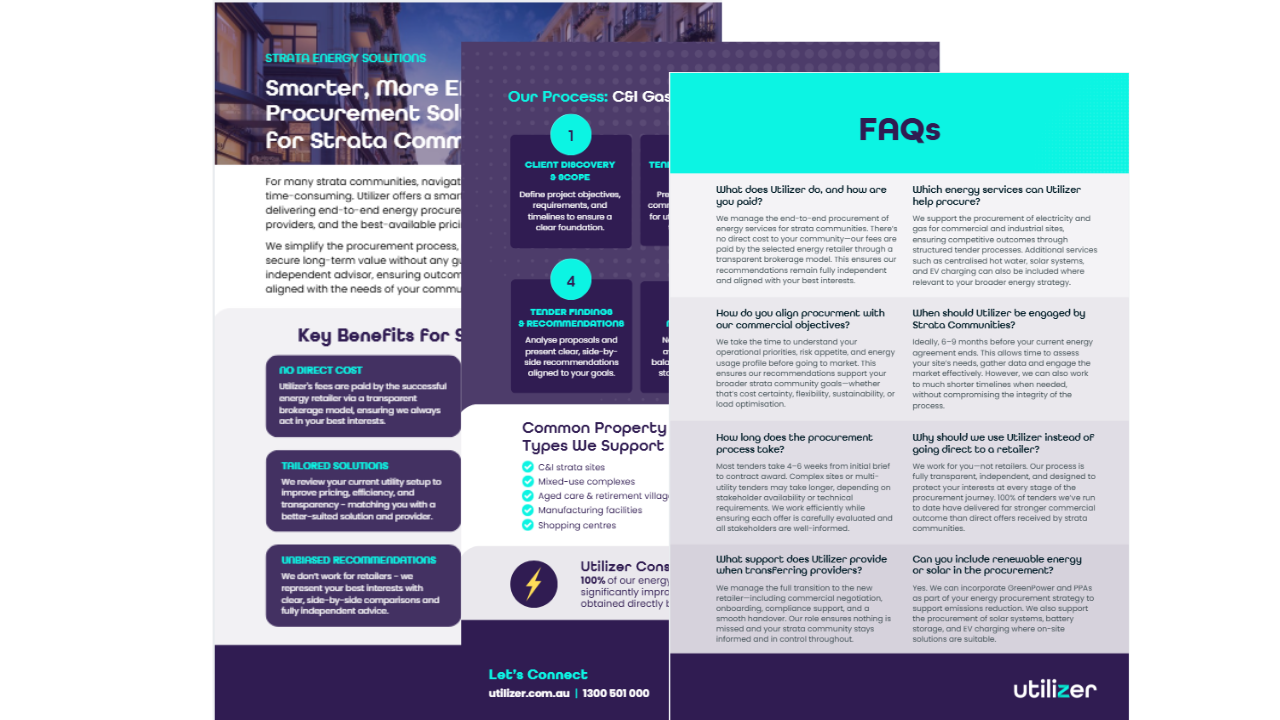
Download our Embedded Network Benefits & FAQs
Guide for Strata Communities.
Our Independent Procurement Approach
We run a disciplined, full-market process that gives your committee clear visibility, real choice and confidence in the decision.
Our fees are paid by the successful provider through a transparent brokerage model, with no direct cost to your community. We receive the same fee regardless of which provider is selected, ensuring our advice remains unbiased and focused solely on achieving the best outcome.
Client Discovery
& Scope
Define project objectives, requirements, and timelines to ensure a clear foundation.
Tender Preparation
& Approval
Prepare technical and commercial specifications for utility services,, tailored to your property.
Market
Engagement
Invite a full suite of energy retailers to participate in a competitive, independent tender process.
Tender Findings
& Recommendations
Analyse proposals and present clear, side-by-side recommendations aligned to your goals.
Contract
Negotiations
Negotiate the best-available outcome, balancing price, risk, and stakeholder priorities.
Agreement
Execution
Finalise contracts and onboard retailer, ensuring seamless transition and uninterrupted supply.
Our Support Includes
– Independent contract and performance review
– Market testing through a full competitive tender
– Clear, side-by-side commercial comparisons
– Negotiation of stronger pricing and contractual protections
– Independent recommendations aligned to your building’s priorities
– Support with transition, compliance and onboarding
What You Can Achieve
A structured market review at renewal gives your building the opportunity to reset commercial terms, improve performance and regain control. By properly testing the market, many Owners Corporations achieve meaningful cost savings, stronger protections and better outcomes for residents.
– Lower long-term energy and utility costs
– Greater pricing transparency and billing clarity
– Improved service performance and accountability
– Stronger contract terms that protect the Owners Corporation
– Reduced risk at renewal and greater confidence in the decision
– Access to solar, EV and sustainability options where appropriate
We work for you – not retailers – ensuring the outcome is commercially sound, defensible and aligned with the long-term interests of your community.
Approaching renewal or concerned about your current network?
Understand how your current arrangement compares to the market and where value may be recovered.
Utilizer Consistently Delivers
100% of our embedded network procurement tenders have achieved significantly improved commerical outcomes, compared to those obtained directly by Strata Communities. Ask us how.




Forward-Thinking
Proactively seeking new opportunities for
our clients

Committed
Invested in our client's energy success over the long haul
Client-First

Accountable
We take responsibility for our decisions, actions
& results

Transparent
Open, honest & transparent communication forms our foundation
OUR CORE VALUES
Our Values That Lead to Your Success
Our core values are the foundation for what we stand for as a leading energy consultancy, and they have remained steadfast since we first helped small businesses lower their energy costs.
At Utilizer, our values—Forward-Thinking, Committed, Accountable and Transparent—form the backbone of everything we do. Each of these values is underpinned by our Client-First focus.
Without your success and trust, we wouldn’t be one of the leading energy consultancies empowering Australian businesses to take control of their energy future.
We make energy easy.
More power to you.
Ready to power up your energy strategy? Plug in with one of our energy consultants today.
If you’re ready to take control of your energy strategy, fill out the form below to schedule a no-obligation consultation with our expert energy consultants. We’ll show you how we can empower you to optimise efficiency, cut costs, and drive sustainable growth.
Your journey to a better energy future starts now.
FAQs
Your Important
Questions Answered
Our embedded network contract is coming up for renewal. Where do we start?
Start by engaging Utilizer early, ideally six to nine months before your current agreement expires. The most important thing is not to let the renewal default to an automatic rollover with your existing operator. That's the outcome operators are hoping for, and it's rarely in the best interests of the owners corporation or occupants. Early engagement gives us time to audit your current arrangement, benchmark it against the market, and run a proper competitive process that puts you in the strongest possible negotiating position.
How do we know if our current operator is giving us a fair deal?
Honestly, unless you've independently benchmarked your current terms against the market, you probably don't. Operators have little incentive to flag when their pricing is no longer competitive, and arrangements that were reasonable when first negotiated can look very different several years on. Utilizer audits your current agreement, compares occupant charges against retail market rates, and assesses whether the commercial structure still serves the interests of the owners corporation and occupants. That independent view is the starting point for any renewal strategy.
How do we know if our building is the right size for Utilizer to add value?
The scale of your building does matter. A structured renewal process makes the most sense where there are enough lots and sufficient energy spend. If you're unsure whether your building meets that threshold, talk to us early. We'll give you an honest assessment upfront, and if we don't think we can add meaningful value, we'll tell you that too.
Is it worth running a competitive tender at renewal, or should we just renegotiate with our existing operator?
A competitive tender almost always produces a better outcome than a direct renegotiation, even if you ultimately stay with your existing operator. The reason is simple: competition changes what operators are willing to offer. When your incumbent knows they are being compared against the full market, pricing structures, service commitments, and contract terms all improve. Without that competitive pressure, you are negotiating with limited leverage and no market context to push back against what you're being offered.
What commercial improvements can a renewal typically deliver?
What a renewal delivers depends on how your current agreement compares to today's market. Whether your current terms have fallen behind over time or were never as strong as they could have been, a competitive process can deliver meaningful improvements across occupant charges, contract flexibility, and operator service commitments. A renewal can also reset the commercial relationship with the operator, creating an opportunity to negotiate infrastructure investment for upgrades, repairs, and improvements that might otherwise have been left on the table. Either way, testing the market ensures you're renewing from a position of knowledge rather than assumption.
How long does the renewal process take?
Most renewals take four to six weeks from initial brief through to contract award, though more complex sites or multi-utility arrangements may take longer depending on stakeholder availability and the scope of services involved. We work efficiently without cutting corners, making sure every offer is thoroughly evaluated and all stakeholders are well informed throughout. The more lead time we have, the stronger the process and the better the outcome, which is why we recommend engaging us at least six to nine months before your current agreement expires.
Can we include solar, EV charging, or other services as part of a renewal?
Yes, and a renewal is often a good opportunity to explore what's now possible that wasn't available or viable when the original agreement was signed. Solar, EV charging, and other building services can be incorporated into a renewed arrangement where the site configuration supports it. We assess what's genuinely feasible for your building and factor those requirements into the tender and provider selection process, so any additions are commercially sound rather than just aspirational.
What support does Utilizer provide when transferring to a new provider?
We manage the full transition process, including commercial finalisation, provider onboarding, compliance support, and operational handover. Our role is to make sure nothing falls through the cracks and that your owners corporation and residents experience a seamless changeover with no disruption to supply or billing. We stay involved until the new arrangement is fully operational and you're satisfied everything is running as it should.
How do we communicate the renewal process transparently to lot owners and occupants?
Transparency throughout the renewal process protects the strata committee or owners corporation and builds trust with owners and occupants. Having an independent specialist manage the process means the outcome is defensible, the recommendations are unbiased, and your committee or owners corporation can communicate the result with confidence.
How do recent regulatory changes affect our options at renewal?
Regulatory changes are gradually shifting the balance of power toward owners corporations and occupants. Stronger consumer protection requirements, new pricing disclosure obligations, and evolving exemption frameworks are giving buildings more rights and operators more accountability at renewal time. At Utilizer, protecting the interests of all stakeholders has always been central to how we work, so in many ways the regulatory direction simply reflects what we've been doing from the start. We monitor these changes and factor them into every renewal strategy we develop, so you're taking full advantage of the protections and flexibility now available to you.